
Intended for US residents only
Intended for US residents only

 Intended for US residents only

Join Dr Carpenter for a detailed review of how to assess your chronic GVHD symptoms, and learn how to best communicate your symptoms with your care team.


Hello. I’m Dr Paul Carpenter, a hematologist oncologist, and blood and bone marrow transplant physician.
Today, I will take you through how our team assesses and manages chronic graft-versus-host disease, or chronic GVHD, at and after the critical day 100 post-transplant milestone
Chronic GVHD often begins with subtle changes such as dry or watery eyes, mouth pain when eating certain foods, or skin-related symptoms such as redness or scaliness1
The goal is to diagnose cGVHD early, before minor symptoms worsen to the point of impacting daily activities or even becoming life threatening.1,2 When early signs are detected, we take a proactive approach, including early intervention with systemic therapy, to help prevent cGVHD from progressing
Some changes may first become noticeable to patients themselves. Thus, as clinicians, we recognize that effective symptom assessment hinges on patients being active participants in tracking their own symptoms
Symptom tracking is important because signs and symptoms of cGVHD can be subtle. By noting how you’re feeling and how your daily activities are affected, we can better understand the impact of your symptoms and stay proactive in your care1.
If you notice any visible changes, we recommend you take pictures and save them in an album on your phone to share with your healthcare provider
A symptom tracker tool, such as the one available for download here, can also help you monitor and record your symptoms.
You can also use an app on your smartphone or tablet, like the Prezerve Post-transplant Symptom Tracker
The Prezerve app lets you select symptoms by organ system or enter a custom symptom, rate symptom severity, and attach photos to share with your healthcare provider
Any photos or symptom tracking you show us or details from the pre-visit questionnaire inform our discussion and help guide us where to focus during the physical examination; this enables quicker identification of early signs of cGVHD
Once we finish with the patient history, we then move on to the physical examination.
I’ll begin with the eye exam since it’s usually the first thing I notice.
Your symptom tracking will have alerted us to any issues you may be experiencing, such as dry eyes, crusty secretions, or a frequent need to blink1,4
The information you share here helps us focus the exam to ensure prompt assessments of any signs, and informs proactive diagnosis and management of your symptoms
To uncover subtle signs of dryness or discomfort, you can expect us to ask, “Have you needed to use eye drops more frequently than usual?” or “Do your eyes feel gritty, like there's sand in them?” to help you recall any changes. We’ll document any symptoms, including how frequently you use eye drops, using the NIH ocular scoring system4
We have found that connecting symptoms to how they impact day-to-day tasks makes them easier for you to recognize and report them
So, we might ask some contextual questions to help you recall changes you may be experiencing. For example, we may check for signs of light sensitivity by asking, “Does it feel more difficult to open your eyes when you wake up?”
Eye symptoms are easy to mistakenly attribute to other causes, like seasonal allergies. This is why we stress the importance of involving ophthalmologists or optometrists for a detailed eye exam after the clinic visit4
The eye exam helps to detect subtle changes post-transplant that are linked to increased risk of eye cGVHD later, but are not yet evident in the symptoms reported by patients at the time3
Delayed diagnosis and treatment of ocular cGVHD can lead to damage that can permanently impair vision and restrict your quality of life3,5
Since early detection of ocular chronic GVHD is so important, in our practice, we now conduct routine eye screening exams with an optometrist or ophthalmologist every 3 months in the first year post transplant
Our next step is to conduct the range of motion assessment to quickly identify any joint symptoms, skin thickening, or any restrictions in movement–all potential signs that your sclerosis or fasciitis is affecting your joints1
I’ll have you put your hands together in the namaste position, and I’ll look closely at your wrists and fingers to ensure you’re able to extend them fully
I’ll then ask you to make the touchdown sign with your arms, watching to ensure you have full range of motion in the shoulders
I’ll then ask you to hold your arms out to the side, elbows locked, with palms up
[Johan] And I could see just a little bit of dimpling here. And I can see the pigment change there on that side
I’ll have you perform the “step on the gas” position and then ask you to bring your foot all the way back, as far as you can go. What I’m looking for here are signs of any tightening of the Achilles tendon making it harder for you to lift your foot upward1
I’ll pay attention to whether you seem to be struggling with these exercises and ask you if you’re having any feelings of unexplained stiffness, muscle cramps, pain, or tenderness, since this may suggest development of cGVHD in your joints or connective tissue1,4
At this point we will also take baseline photos to use as a reference for future visits1
Here I will remind my colleagues that because some people are more flexible than others, especially children, it is important to have photos for each position at the initial or baseline visit, in order to accurately assess if anything has changed during follow-up
Your care team will use a special scale called the Photographic Range of Motion scale or P-ROM to record the results of these assessments1,3
If we miss signs of minor decline in range of motion or joint symptoms, your disease may progress and lead to significant restrictions in mobility
By proactively detecting early changes in range of motion, we improve our chances of starting treatment at the right time before irreversible loss of mobility associated with cGVHD can set in
Next, we examine the inside of your mouth to look for any signs of redness, white patches, sores, or painless bumps–potential signs of cGVHD that are known to clinicians as erythema, lichenoid lesions, ulcers, or mucoceles1,4
I may also ask questions to better assess the impact that subtle mouth symptoms may be having on your daily life. For instance, “Do you experience pain or sensitivities when you eat certain foods?”
If you notice any new discomfort with toothpaste, acidic drinks, carbonated beverages, or spicy foods, you can record it in your symptom tracker and mention it during your visit
[Demonstration with Dr Carpenter and patient Clay]
What about your mouth? How’s that feel?
[Clay] Still a little bit of oral GVHD
Okay. What's the dryness like?
[Clay] The dryness is fine. I just have some tenderness and ulcers
Do you have some ulcers? Are they responding to the therapy we gave you last time, do you think?
[Clay] Yes
And what makes you convinced about that?
[Clay] They’ve lessened
Okay. And any swallowing discomfort?
[Clay] No
Anything get stuck when you swallow?
[Clay] No
Okay. And any sensitivities to toothpaste? Hot, cold?
[Clay] No
I examine the mouth for any sign of abnormalities
The redness will appear anywhere from a strawberry color to a red raspberry color compared to the normal, more pinkish color of the mouth1
[Johan] So, on that side there's just nice, moist mucus membranes there. I can see your linea alba. There's a little tiny white patch there, but that's not typical.
Often white squiggly lines or patches represent cGVHD, whereas sores or ulcers will appear deeply red with a yellowish coating
Moving on to the skin
We start with a visual inspection of the entire skin surface. Early signs of cGVHD in the skin can be as subtle as excessive skin dryness, scaliness, or persistent goose bumps9
Skin cGVHD commonly presents as redness; however, in patients with darker skin tones, it may appear more purple than red10,11
If you notice any new changes in appearance such as patches, unusual coloration, or bumps, you can track these changes by taking pictures and monitoring them daily on the symptom tracker
When early signs are missed, redness can spread to cover more than 10% of the body surface area and increase the patient’s risk of death. One study showed a 28% greater risk of death with each 10% increase in the area affected with redness11
When I catch subtle signs of skin cGVHD, such as dryness, redness, or small changes in appearance, I take an aggressive approach, including early intervention with systemic therapy to help prevent disease from spreading and impacting survival
[Langdy] Just first of all, look at your nails, which are part of the overall skin. You've got a little vertical ridging
Has this been the case for you?
Yes
So here we can see just hold your thumbs up like that.
So, there is some discoloration of this nail and some vertical ridging, which is a subtle sign of graft-versus-host disease.
As part of the physical examination, we also look for what we call dimpling or rippling, which is unusual wrinkling or areas of wavy or uneven skin. We also do what we call a pinch test to see how elastic the skin and deeper tissues are and whether it snaps back into place properly
I’ll start with your hands, moving them as I look and feel them. I perform the pinch test systematically, quickly examining major areas of the skin across the body1
[Johan] Relax - so in the relaxed position you can see this tight tendon, and this hyperpigmented, almost a groove sign. And the tissue, the deep tissue under there is very firm.
Early skin cGVHD may be more difficult to readily recognize in skin of color, which can lead to later or missed diagnosis. In my patients with darker skin tones, I closely examine the skin for brown to dark purple lesions or a slate-gray appearance in sun-exposed areas to detect subtle signs of disease10
[Langdy] You can see that there's some loss of pigment just over the metacarpal joints here, and in these interphalangeal joints.
But some of them appear to have some central re-pigmentation.
And this is the importance of archive medical photos. We will compare these to the photos we have of your skin before to see whether those are, in fact, filling in.
Because as you mentioned, it's hard to remember.
[Langdy] And, on this side we've got some vitiligo, or hypopigmentation.
And again, some of that looks like it might be re-pigmenting in the middle of all of these spots, which we would have to see how much of that big white area was previous more white than this, with these little areas that appear to be islands of re-pigmentation.
So, on the back - most of this body part of the whole back - is involved with vitiligo, with areas of re-pigmentation.
There's no erythema.
And then we're just going to also do a pinch test while we have you in this position. And this is all soft and supple.
There's no signs of superficial or deep sclerosis.
After the early stage, skin cGVHD may progress into more-recognizable signs–such as rough, patchy areas or thickened, tight skin–that clinicians may refer to as lichenoid or sclerotic lesions
If we notice any of these signs, we then move on to a deep tissue test that involves pressing a bit harder on the areas of the skin to ensure we don’t miss anything either on the surface of the skin or below it
For my colleagues, I want to emphasize that our main goal is to ensure that any signs of sclerosis are evaluated objectively and are not missed until they advance into highly morbid or debilitating changes from cGVHD1
Again, we work systematically, focusing on about 17 areas of the skin using the modified Rodnan scoring system, which helps clinicians to assess the degree of skin roughness and thickening1,12
[Clay] We've got pretty clear-looking skin. I don't see any signs of redness.
But I'm not seeing any signs of superficial sclerosis.
When we look on the lower limbs we can see what appears to be some sclerosis here, superficial.
[Clay] And I can see it's blanching.
And the skin is pretty tight there. So that's an area of superficial sclerosis.
[Clay] And down here I cannot pinch this together, so this is hidebound skin. It blanches when I try to pinch it… So that's on the lateral foot.
The range of motion assessment is another tool for helping us find tightness or thickening to uncover signs of sclerosis that may have been overlooked with just a visual inspection of your skin3
Consider this example. On initial inspection, the patient’s skin appeared normal. But they were unable to close their fists tightly. They wouldn’t have been able to grip golf clubs. Though the skin surface seemed unremarkable, they struggled with movements, such as bringing their fists together in the prayer position. This reveals subtle yet clear signs of inflammation of the connective tissue under the skin–also known to clinicians as fasciitis–which could have been easily missed
If left unchecked, these subtle signs of swelling can progress to sclerotic changes, limiting daily activity and causing potential irreversible loss of skin flexibility and mobility1. This is why we focus on thorough assessments to diagnose and intervene early with systemic therapy in cGVHD
After we have completed the skin examination, we assess the patient for signs of gastrointestinal or liver issues
If cGVHD affects your esophagus or upper gut, you may have problems swallowing. To assess this, our team asks questions like, “Is it painful to swallow? Does food get stuck?”1,4
When we suspect the gut may be impacted, we ask about nausea, weight loss, number of bowel movements, and if your stool is loose or watery1,4
This, in addition to results from your regular liver function tests, informs us about early signs of cGVHD in the liver
Lung-related symptoms can be particularly challenging to diagnose
The most important information for assessing cGVHD of the lungs comes from the patient’s history and the results of pulmonary function tests (PFT)
We ask if you have noticed a persistent cough, wheezing, a feeling of exertion, or any shortness of breath—especially after activities that used to feel easy—as these may be early signs of lung cGVHD1,4
You can use your symptom tracker to make note of any daily activities that start to become more difficult due to shortness of breath or lack of energy
The cadence of PFTs is particularly important for catching lung cGVHD early1
If there are no signs of cGVHD, we will perform a PFT before the transplant, at 3 months, at 6 months, and at 1 year post transplant. If you develop cGVHD at anytime, the cadence will change from annually after year 1 to approximately every 3 months while you are undergoing treatment for cGVHD
Without regular PFTs, there is a chance that lung cGVHD may go undetected until your breathing is compromised
That’s why we prioritize regular PFTs—to identify early signs of lung cGVHD and act by initiating therapy early before lung damage becomes life-threatening
We will share information with you on how changes due to cGVHD can also affect your genitals. We understand that discussing genital health can be uncomfortable for patients, which can lead to underreporting. But it’s an important part of your overall health, and we want you to be aware that we’re here to support you without any judgment
For male patients, we usually incorporate a genital exam into the whole-body skin exam while you’re lying on your back. For female patients, your exams need to be scheduled with a gynecologist
We encourage you to stay vigilant for any new dryness, rash, burning sensation, pain during sexual activity, or any changes in sexual activity, as these may indicate the onset of cGVHD1,4
If you experience any of these changes, such as dryness or discomfort affecting intimacy with your partner, you can use the symptom tracker to keep a record of this and bring it up with your care team
During your visit, we may ask some clarifying questions about your complaint, such as “When do you experience this discomfort?” to better understand the context of your symptoms
This helps us determine whether genital symptoms may be a sign of cGVHD or are related to other factors such as hormone imbalance
Throughout the examination, we use a standardized system known as the NIH consensus criteria to score positive findings in each affected organ system and document them in our electronic medical record (EMR). Scoring helps us understand the overall severity of your disease and provides a more-defined framework to track changes in each organ over time1,4,13
We want to emphasize that thorough evaluation and documentation of each organ is essential. Neglecting to assess an affected organ can lead to a delay in treatment and disease progression13
We recognize how overwhelming it can be to constantly monitor and discuss your symptoms while also managing your overall health
But we want to assure you that proactively keeping track of your symptoms is critical for us to understand how well you are responding to treatment and to ensure we are supporting you effectively14
At each follow-up visit, we objectively assess if there are any changes to your symptoms and will consistently document them to ensure we have a clear comparison over time
We use detailed records, including photographs and the modified Rodnan scoring system, to monitor your treatment progress and make informed decisions about your care1,12
Ultimately, the best practice for managing cGVHD is to act with urgency in identifying subtle symptoms and prioritizing early intervention, including systemic therapy, to have an impact on a patient’s life
As a patient or caregiver, it is important that you actively monitor for signs and symptoms of cGVHD, using tools like the symptom tracker, to keep a record. It is vital that you continue to communicate changes with your care team as your partnership in this process guides our approach and helps us support you better
As your transplant care team, we will stay attentive to your input and perform careful assessments and documentation to ensure that we can proactively identify early signs and symptoms of cGVHD
We believe that this partnership approach to cGVHD care will help improve your quality of life post transplant
Thank you for watching

Chronic GVHD often begins with subtle changes ... the goal is to diagnose chronic GVHD early, before minor symptoms worsen to the point of impacting daily activities or even becoming life-threatening.
GVHD Expert


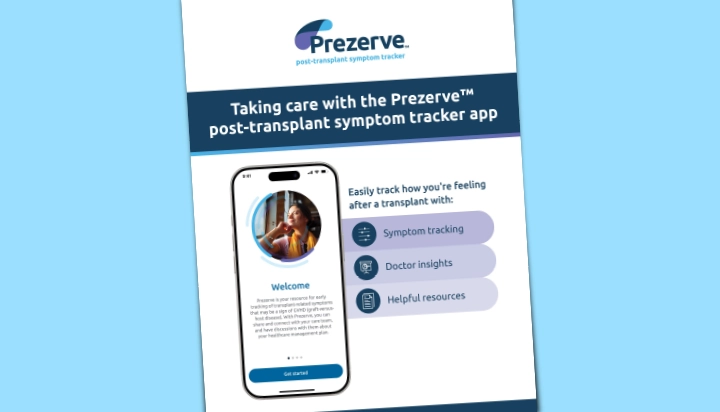
Prezerve™ app How-To Guide
This guide will help you set up and use the Prezerve™ post-transplant symptom tracker app to support your post-transplant journey.

Download the Prezerve™ app
Click the button below to download the Prezerve™ post-transplant tracker app.